
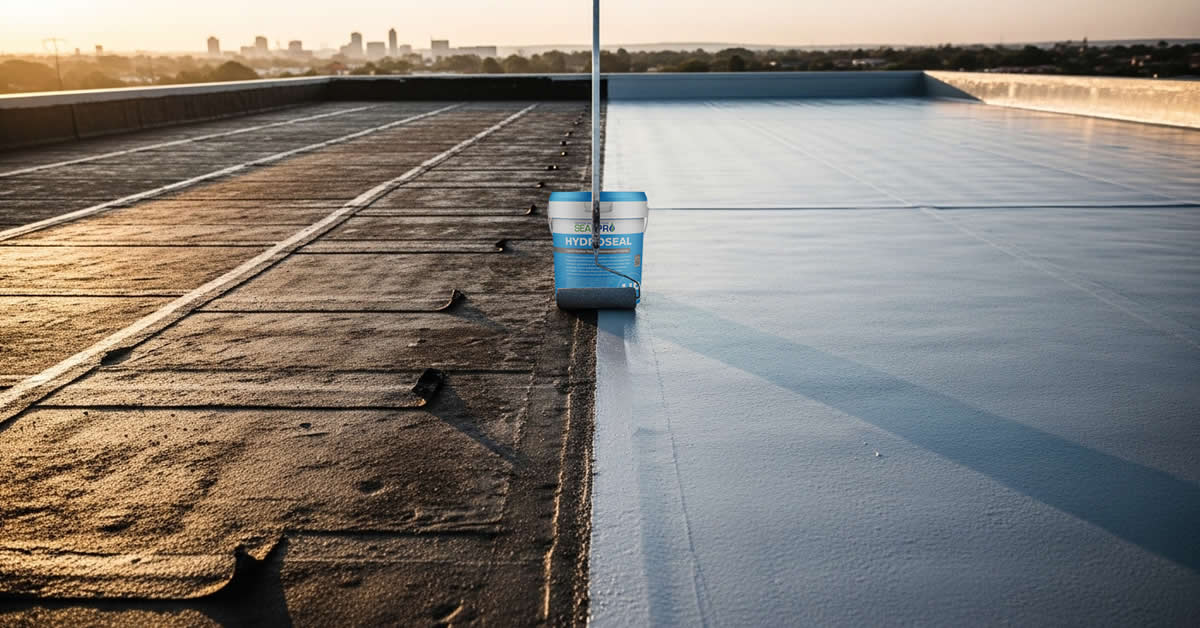

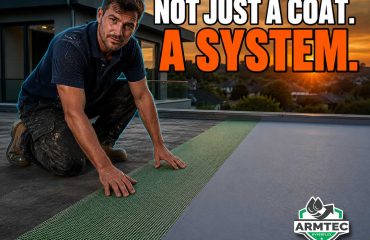

Torch-On vs Liquid Waterproofing: Which System Is Right for Your Roof?
TL;DR
For most South African flat roofs in 2026, liquid waterproofing is the superior choice:
- Lasts Longer: 10–15 years (vs. 5–10 for torch-on).
- Fewer Leaks: Seamless application with no joints, overlaps and outlet termination points to fail.
- Safer: Eco-friendly, No open flames or fire risk.
- Cheaper Repairs: The ArmTec HyperFlex Torch-On Repair System is applied directly over old torch-on, halving costs by skipping the strip-and-demolish step, repairing the old system and gaining a new waterproofing system over the existing one.
*Torch-on still makes sense for large commercial slabs and parking decks.
If you own a house with a flat roof in South Africa, sooner or later, it is going to need waterproofing. And the moment you start asking questions, you’ll run into the same fork in the road: torch-on or liquid waterproofing?
The debate gets heated. Old-school contractors swear by torch-on bitumen membranes because it’s what they’ve installed for thirty years. Newer applicators push liquid systems because they’re faster, safer, and — for most situations — longer-lasting. Both sides have a point, and both sides are selling you something.
We manufacture liquid waterproofing systems, so we’ll be upfront about our bias before we go any further. But we’ve also applied both, specified both, and had to repair both. This guide is an honest comparison of torch-on vs liquid waterproofing — where each one wins, where each one fails, and how to decide which belongs on your roof.
How torch-on waterproofing actually works
Torch-on (also called SBS or APP bitumen membrane) is a rolled sheet made of modified bitumen, usually 3mm to 4mm thick, with a polyester or fiberglass reinforcement layer in the middle. The underside is covered with a thin plastic film that burns off during installation.
The application is exactly what it sounds like. An installer unrolls the membrane across the prepared roof surface, then uses a handheld propane torch to heat the underside. The bitumen melts just enough to fuse the sheet to the primer below and to the overlapping edge of the previous sheet.
When done well, you end up with a continuous waterproof barrier made of interlocking strips. When done poorly — and we’ll get to that — you end up with a roof full of weak overlap joints waiting to fail.
How liquid rubber waterproofing actually works
Liquid rubber-applied waterproofing is a coating, not a sheet. The installer rolls, brushes, or sprays a primer onto the prepared roof, then applies two or three coats of a polymer or acrylic membrane directly over the surface. In most modern systems, a fibre mesh is embedded between the coats to reinforce weak points like outlets, parapet junctions, and existing cracks.
Once cured, the coating forms a single seamless membrane. No overlaps. No joints. No seams to fail.
The difference is fundamental. Torch-on gives you a sheet that happens to be stuck to your roof. A liquid rubber waterproofing system gives you a membrane that becomes part of your roof.
Torch-on vs liquid rubber waterproofing: side-by-side
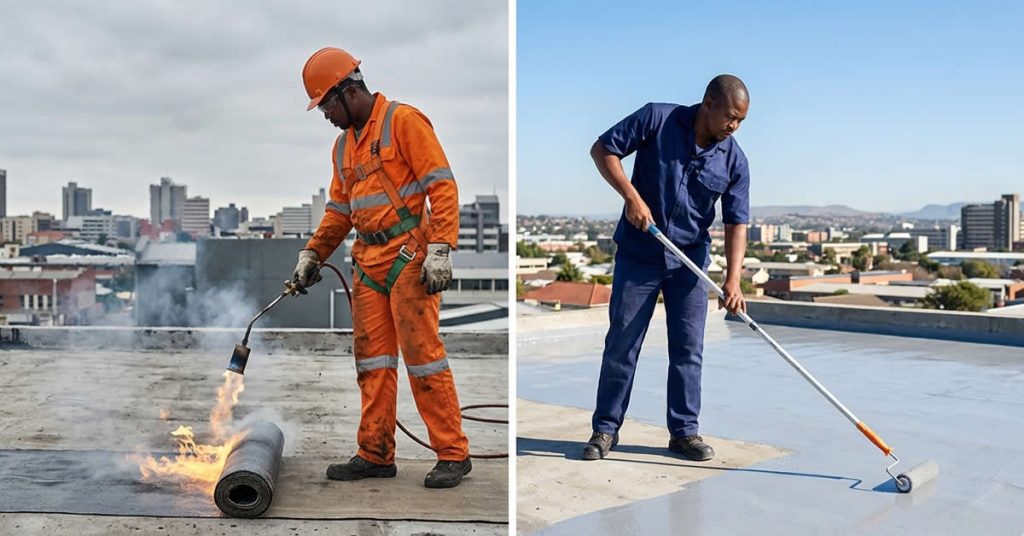
Here’s how the two systems compare on the factors that actually matter when you’re writing a cheque:
| Factor | Torch-On Membrane | Liquid Waterproofing |
|---|---|---|
| Typical cost per m² | R295–R480 (new installation) | R285–R400 (new installation) |
| Expected lifespan | 8–10 years in SA climate | 10–15 years with proper prep |
| Application time | Faster on large open areas | Faster on detailed roofs with many penetrations |
| Seam integrity | Multiple overlap joints — weakest points | Seamless — no joints to fail |
| Repair complexity | Patching requires cutting, heating, re-sealing | Touch up with another coat in the affected area |
| Fire risk during install | High — open flame on your roof | None — water-based application |
| Can be applied over existing waterproofing? | Rarely — usually requires stripping | Yes — over bitumen, over torch-on, over most substrates |
| Suitable for complex details | Difficult around outlets, upstands, skylights | Excellent — flows into detail areas |
Where torch-on still makes genuine sense
It would be unfair to pretend torch-on has no place on modern roofs. It does.
New construction on large open slabs. If you’re waterproofing a fresh concrete slab with few penetrations and generous open area, torch-on can be installed quickly and economically by an experienced crew. The economics work because the roll rate is high and the detailing is minimal.
Budget-constrained commercial projects with short holding periods. If a developer is putting a roof on a building they plan to sell within five years, torch-on delivers a compliant waterproofing solution at a lower upfront spec level than a premium liquid system.
Notice what’s missing from this list: the average South African home.
Where torch-on fails — and why it’s the wrong choice for most roofs
Torch-on’s weaknesses aren’t theoretical. They’re the same failure modes we see on repair callouts every week.
Overlap joints are the first to go. Every sheet of torch-on has edges that overlap the next sheet. Those overlaps are sealed by heat during installation, but they’re never as strong as the middle of the sheet. Over time, thermal expansion and contraction work those joints open. Water finds the weak seam and travels laterally under the membrane until it finds somewhere to drip.
UV breaks down the surface. South African UV is aggressive. Bitumen loses its volatiles under sustained sun exposure and becomes brittle. Brittle membranes crack when they flex, and flat roofs flex every single day as temperatures swing.
Detailing is where installers cut corners. The open areas of a torch-on roof are easy. The tricky parts are the outlets, upstands, parapet wall returns, and anywhere pipes penetrate the roof. These details get hand-worked with offcut pieces of membrane, mastic, and flame — and they’re where most torch-on roofs leak first.
The fire risk is real. Open-flame torches on a roof have caused structure fires in South Africa, particularly on older roofs with timber substructures or combustible insulation below the slab. It’s not a hypothetical risk.
Repair means demolition. When a torch-on roof fails — and it will — the traditional fix is to strip the old membrane, re-prime, and reinstall. This is a labour-intensive, messy, expensive process that often costs more than the original installation.
Why liquid rubber waterproofing has displaced torch-on for most residential work
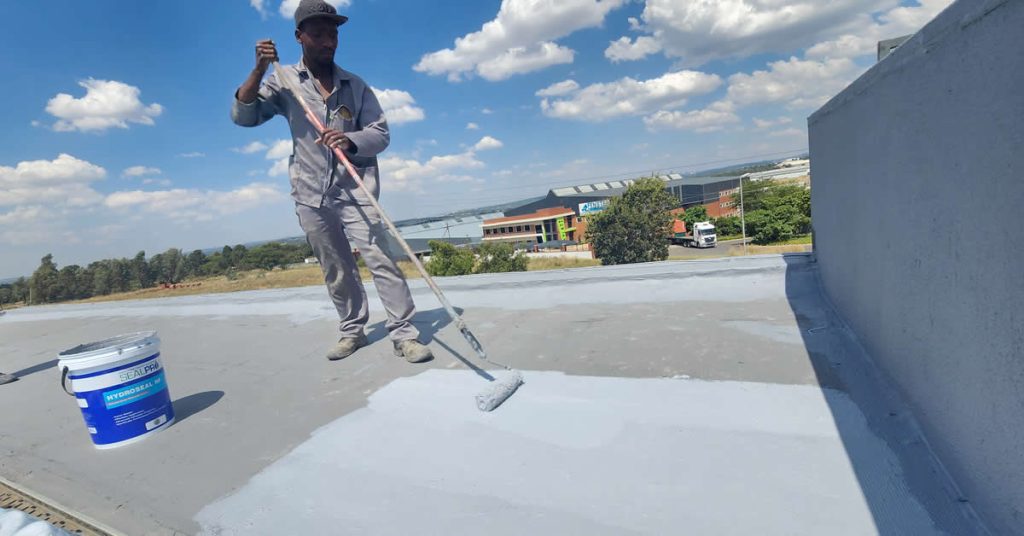
The rise of liquid-applied systems in South Africa isn’t marketing hype. It’s a response to torch-on’s practical limitations.
A modern liquid rubber waterproofing system, like the ArmTec HyperFlex waterproofing system applied with mesh reinforcement gives you a seamless membrane that flexes with the building, resists UV damage far better than bitumen, handles complex detailing without handcrafted workarounds, and eliminates the fire risk entirely. When it eventually needs maintenance (4 years in), you apply another coat. No stripping. No demolition. No landfill.
For the complex roof profiles typical of South African homes and small commercial buildings — with skylights, solar geysers, multiple outlets, parapet walls, and upstands — liquid waterproofing simply does the job better.
The best reason to choose liquid: you can apply it over existing torch-on
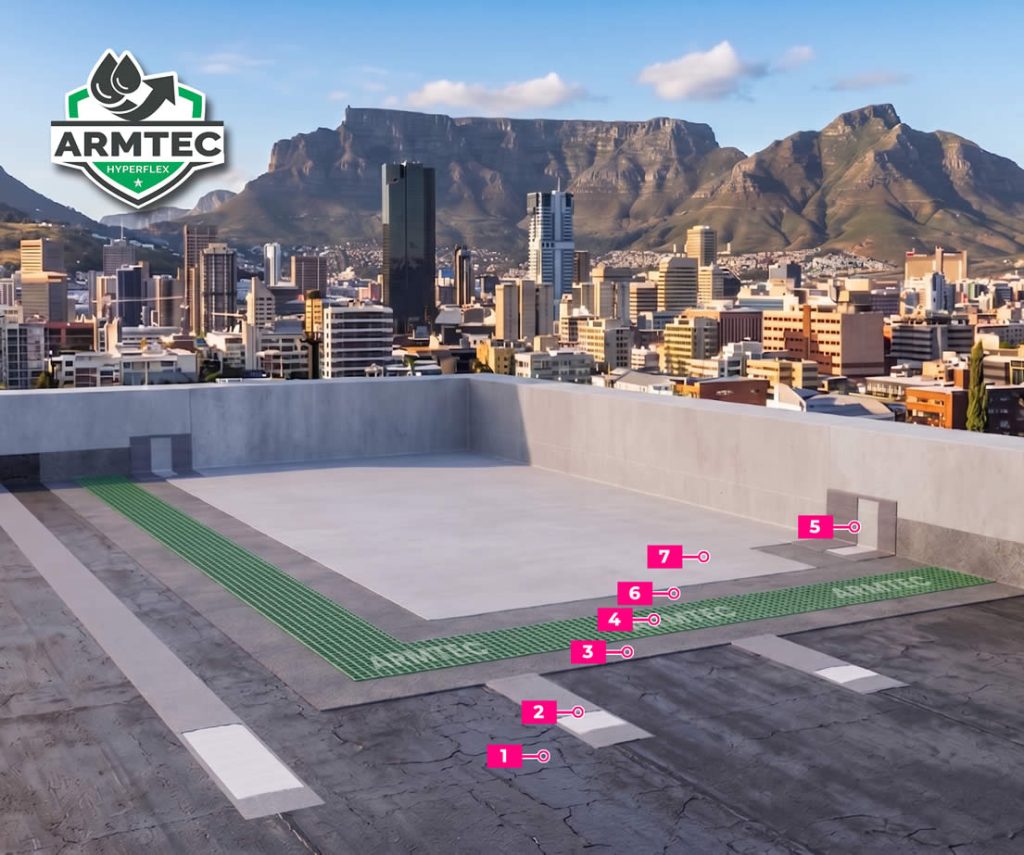
This is the detail that changes the economics completely.
If your roof already has torch-on on it, and it’s failing, a traditional contractor will quote you R450+ per square meter to strip, prepare, and reinstall a new membrane. That’s before they’ve even added the cost of removing and disposing of the old material.
A liquid-applied system designed as a torch-on alternative can be installed directly over the existing membrane. No stripping. No demolition. The old torch-on becomes a substrate for the new seamless coating on top.
That’s the principle behind our ArmTec HyperFlex system. It adheres to existing bitumen-based waterproofing, incorporates mesh reinforcement at vulnerable points, and renews the roof without the expense and disruption of a strip-and-replace. For most failing torch-on roofs in South Africa, this is the right answer economically and technically.
If your existing torch-on is intact but ageing, you can find more detail on applying waterproofing over torch-on and the specific surface preparation it requires.
If you’re an applicator looking at the full system in depth, our newer article goes through the five sub-systems of ArmTec HyperFlex and what each one solves.
Environmental and safety considerations
This part doesn’t usually make the quote comparison, but it’s worth raising.
Torch-on installation requires open flame at roof level. That means propane gas cylinders on the roof, potential for sparks to ignite adjacent materials, and the inevitable smoke that drifts across neighboring properties. In body corporate buildings and sectional title complexes, this can be a genuine compliance problem.
Modern water-based liquid systems are low-VOC, non-flammable, and safe to apply in occupied buildings. Workers aren’t exposed to burning bitumen fumes. Your neighbors don’t complain. Your insurer doesn’t lose sleep.
So which should you choose?
For a brand new, large, open commercial slab with minimal penetrations where upfront cost is the main driver — torch-on remains a defensible choice.
For almost every other situation in South Africa — residential flat roofs, roofs with complex detailing, failing existing torch-on, buildings that are occupied during installation, long-term-hold properties — a liquid-applied system will serve you better. It costs less per square meter in most cases, lasts longer in SA climate conditions, fails less catastrophically, and can be renewed instead of replaced.
The bigger question isn’t torch-on vs liquid in the abstract. It’s whether the contractor quoting you understands the trade-offs, specifies the exact system being installed, and can tell you honestly why that system suits your roof. If you’re comparing quotes and one of them is significantly cheaper than the others, find out what’s being left out of the specification — because something will be.
If you’d like a proper look at what your roof actually needs, we can do a free on-site assessment and give you a written, system-specified quote with no pressure attached.